Cold Chain in Transport
Stability Budget Explained
A stability budget is the amount of time a product can spend out of its specified storage conditions without risk to its quality, safety, or...
Learn what Mean Kinetic Temperature (MKT) is, how it’s calculated, and why it’s critical for pharmaceutical stability studies, storage, and GDP compliance.
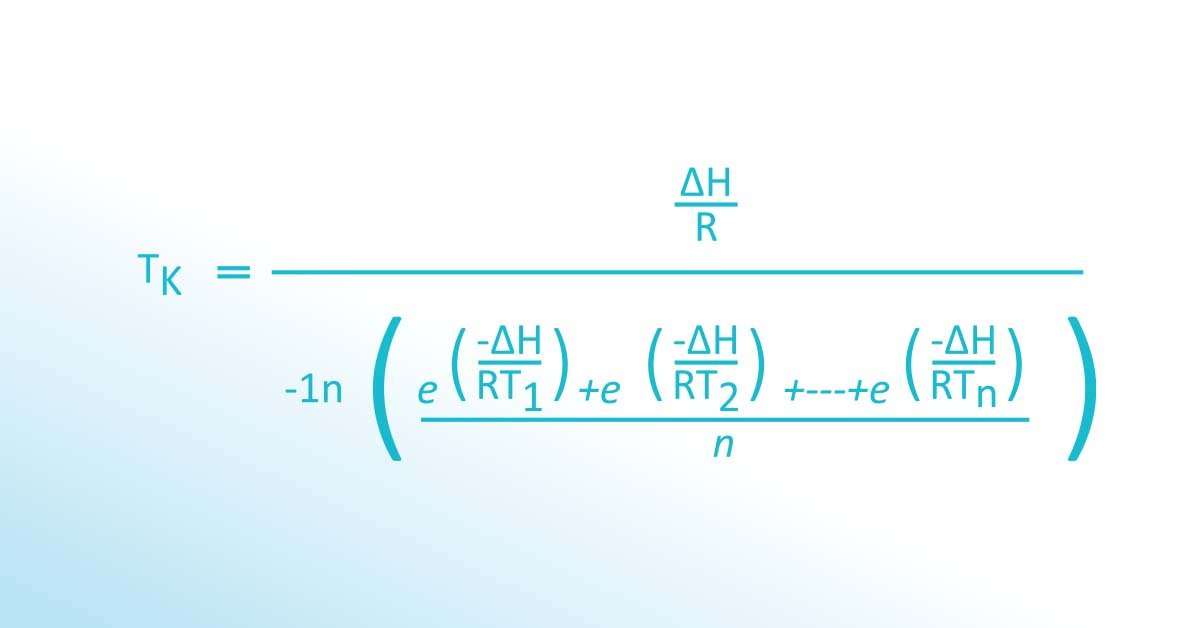
Mean Kinetic Temperature (MKT) is a weighted average temperature which summarizes the thermal challenge a drug substance or product would experience over a range of various temperatures for a defined period of time. It is used during pharmaceutical stability studies to assess the impact of temperature fluctuations on product quality.
Mean Kinetic Temperature (MKT) is used in the pharmaceutical and life sciences industries to evaluate the effect fluctuating temperatures have over time on the efficacy and safety of a drug product. In 1971, J.D. Haynes calculated a "virtual temperature" to predict product expiration when accounting for temperature variability within a given region. The calculation is based on the Arrhenius equation, which describes the relationship between temperature and chemical reaction rates.
MKT represents a single calculated temperature value that simulates the cumulative thermal challenge a drug substance or drug product experiences over a defined time period. By definition, the MKT is higher than the simple arithmetic mean temperature, because it places greater weight on higher temperatures using the Arrhenius equation.
The U.S. Food and Drug Administration (FDA) and European Commission recognizes MKT as a mathematical tool to help assess whether shipping and storage conditions remain acceptable within defined climatic zones.
 Making Sense of Mean Kinetic Temperature
[FREE] Download our Article on Making Nice of Mean Kinetic Temperature (MKT)
Stability Studies:
Storage:
Transport:
The higher—and longer—a drug product is exposed to elevated temperatures, the faster chemical degradation reactions may occur.
A stability budget is the amount of time a product can spend out of its specified storage conditions without risk to its quality, safety, or...
Explore how temperature and humidity monitoring protect pharmaceuticals, biologics, biospecimens and other regulated products from degradation.
Getting started within the Pharma GxP can be quite overwhelming. Most important is to get an overview of what GxP is all about. This article gives...