Cryogenic Storage and Shipping
Fleet Qualifications for Cryogenic Containers
There are several regulations that you must follow when shipping cryogenic containers.
Why is shipping Liquid Nitrogen cryogenic containers so difficult? All about the challenges with shipping cryogenic containers.
As modern medicine advance, technology has to advance in parallel. Active pharmaceutical ingredients (API), freeze-dried compounds, and biological samples are dependent on cryogenic temperatures for safe keeping. What are cryogenic temperatures? -150 °C to -273 °C is the range of temperatures fit for cryogenic storage. Modern cryogenic freezers and canisters are now able to maintain these extremely low temperatures with LN2.
The pharmaceutical industry is getting more comfortable everyday dealing with liquid nitrogen (LN2) as the primary ingredient for cryopreservation.
Teams need training to safely handle the containers and its materials. It takes regular maintenance for cryo container upkeep. Dewar tanks and freezers need to be refilled and charged with liquid nitrogen. The elements inside need to be meticulously monitored with an advanced temperature monitoring system.
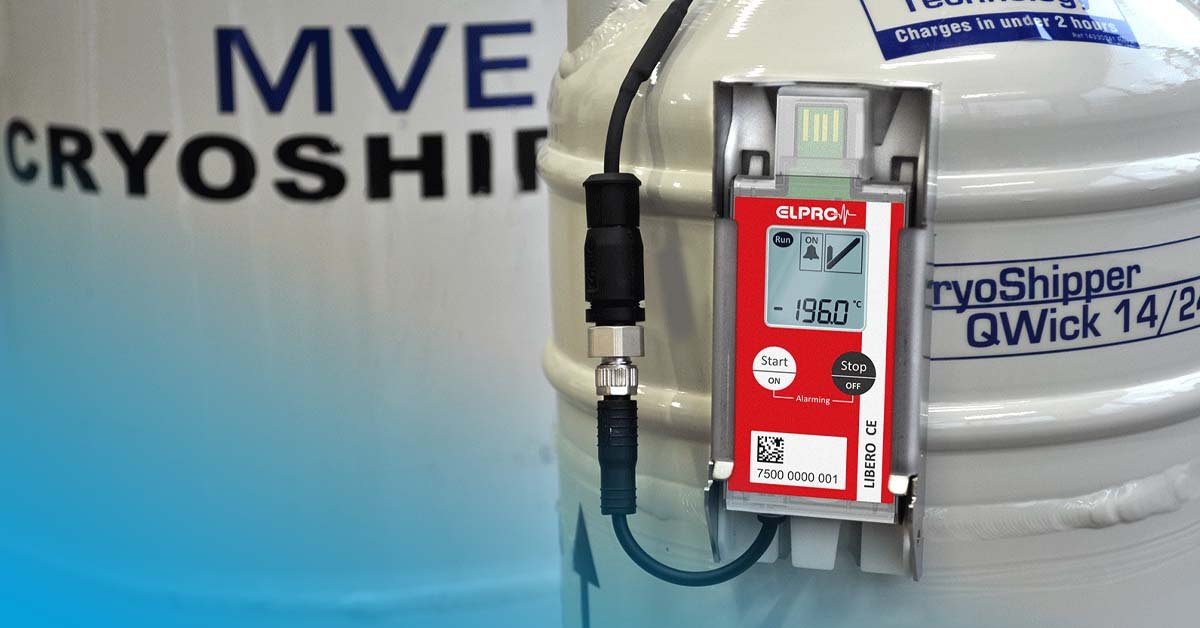
You need monitoring equipment that is capable of reading and storing cryogenic temperatures. ELPRO cryogenic data loggers have an external sensor to monitor cryogenic temperatures inside the canister. Additionally, the data loggers are equipped with an internal sensor to monitor ambient temperatures.
Installing the monitoring equipment can be difficult. One mistake can easily cause irreparable damage to the probe and/or the liquid nitrogen canister lid. Additionally, improper installation will reduce the static hold time significantly. If the probe isn’t positioned correctly, you won’t get an accurate reading on your shipment. For your convenience, ELPRO has professionals ready to install data loggers on your cryogenic containers.
To install the data logger in a pre-charged dry shipper:
Liquid nitrogen data loggers come with a variety of sensor options. Temperature monitoring can be sufficient for a storage container or Dewar. Shipping containers and dry shippers have more risks associated with their stability. Light and acceleration sensors, along with geographic location tracking can significantly reduce risks.
Specialized analytical tools are necessary; regular mercury or alcohol thermometers cannot measure cryogenic temperatures because they freeze. Instead, platinum resistance thermometers must be used. They have a well-defined electrical resistance behavior as a function of temperature. Temperature is an excellent quality control metric that documents tank and Dewar stability.
An easy way to know a container was tampered with is with a light sensor. If the container is exposed to light during a shipment, an alarm will notify the responsible party, and an investigation can be initiated.
An acceleration sensor can measure tilt, shock, and vibration. When it comes to LN2 monitoring, preventing or reacting to tilt in a timely manner can significantly affect hold time or prevent tank failure.
Some data loggers, like the LIBERO GE, have the ability to track its geographic location. In conjunction with real-time technology, a signal is sent through the data logger to let the owner know where their shipment is throughout its journey.
An important consideration when selecting data loggers is battery life. Fortunately, there are data loggers with robust batteries such as the LIBERO GE real-time data logger with external probe.
Monitoring LN2 containers in real time is possible with some loggers via a wired or wireless connection. Real-time monitoring paired with big-data analytics and predictive modeling software can significantly reduce the risks to pharmaceuticals. Real-time data is more critical in cold chain packaging, transportation, and storage in the pharmaceutical supply chain—arguably even more so for LN2 shipments. Integration of the real-time devices into their own software via REST-API goes a long way.
For shipping containers, detecting temperature, tilt, light, and location in real-time enables teams to move fast when they need to. With the influx of cell and gene therapy (CGT), the cold chain will have to grow comfortable with using these kinds of sensors during shipping.
Newer wireless monitoring/alarm-based equipment provides a more versatile option. Users are able to collect and store volumes of data while distinguishing between normal and abnormal conditions in individual tanks.
When alarm parameters are set, real-time applications have the ability to send a variety of notifications. Depending on the system, an audible alarm will sound, lights will flash, phone calls are initiated, and messages are sent via SMS text and email.
Although the wireless monitoring devices can function in a blackout, their reliance on batteries makes them vulnerable. Users should regularly inspect the battery power.
Wireless alarm systems are susceptible to internet outages. It is, thus, critical to have a dependable, dedicated Wi-Fi connection.
Also, IT should give proper warning when computer systems are temporarily disabled to avoid false alerts.
All alarm systems should be tested frequently (e.g., daily to weekly). In addition, the call-out system should be checked regularly (weekly, monthly) to ensure that it is effective, and people are responsive. It should be part of the conventional quality control procedures to assure correct operation. Such testing can aid in the detection of software bugs and equipment malfunctions. Additionally, clear alarm logs regularly to ensure sufficient storage is available. Exceeding the storage capacity may cause recording to halt.
 Vaccine Supply Chain
[FREE] Take a look at temperature monitoring options, the WHO PQS catalogue, information on vaccines for developing countries, etc.
Data loggers with built-in Bluetooth® technology make monitoring your tank or Dewar effortless. They assist in configuring, monitoring, and downloading data without the need for a physical connection using your computer, smartphone, or tablet.
There are data loggers on the market like the LIBERO CE that can be controlled via Bluetooth® technology. See a list of all our LN2 data loggers.
Monitoring cryogenic containers enables companies to identify specific risks to their products. Users have the opportunity to make appropriate adjustments to ensure their contents are safe. For high-value products and samples, real-time monitoring prevents spoilage before it occurs. Modern IoT capabilities are available for stakeholders to immediately respond to container alarms. Cryogenic containers are one of modern medicine's most groundbreaking innovations, and cryogenic temperature monitoring has revolutionized the efficiency of the ever-changing cold chain.
There are several regulations that you must follow when shipping cryogenic containers.
When shipping pharmaceutical products with cryogenic tanks, the selection to choose from is quite big. In this article we summarize the most...
When it comes to cold chain logistics and packaging, a lot of requirements are out there. You need to choose from a broad selection of shipping...