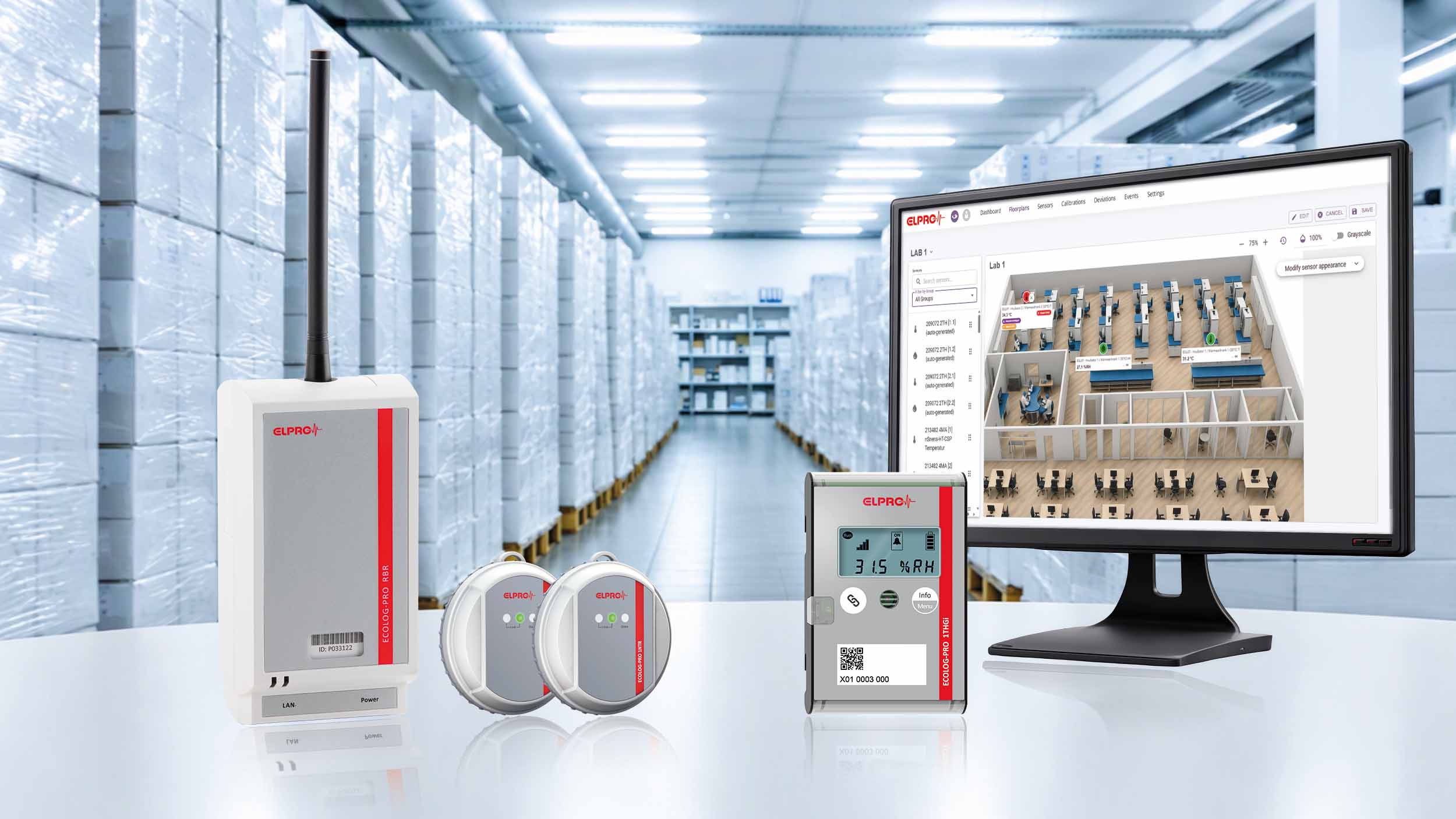
Cleanrooms, laboratories, large warehouses, refrigerators, ULT freezers, cryogenic containers, incubators: in regulated environments, no two pieces of equipment and no two rooms are alike. Each environment has its own monitoring requirements.
Temperature is only part of it. Humidity, differential pressure, particle concentration, CO₂, airflow and door openings all need to be recorded reliably in regulated environments, and the list goes on. Temperatures also cover a wide range, from +400 °C in high-temperature applications down to -200 °C in cryogenic applications. Solutions with a limited sensor portfolio leave gaps in monitoring, and gaps mean compliance risks.
Compliance isn’t the only factor that shapes monitoring requirements. Buildings and IT infrastructure play a role too. A cleanroom has different needs than a warehouse, and an existing building has different needs than a new one. "In clinical trials, study managers need temperature data from different trial sites," says Aleksandra Flatz, Senior Product Manager at ELPRO. "They often depend on the individual locations to provide this data. At the same time, it's not always possible to integrate monitoring devices into the existing IT infrastructure on site."
In practice, a one-size-fits-all approach rarely works for either software or hardware. Pharmaceutical environments are diverse, so monitoring must be just as diverse. What's needed is intelligent software, a broad hardware portfolio and comprehensive services, all working together.
“Even the best monitoring software is only as good as the sensors that feed it data. That's why we've developed a hardware portfolio that truly covers every use case.”
Sascha Schultes, Product Manager, ELPRO
Where All Data Comes Together: elproMONITOR Cloud
Before looking at sensors and probes, let's start with the software platform: elproMONITOR Cloud. All measurement data comes together in the software, whether it's transmitted wired, wireless or via the cellular network. This is where limits are monitored, alarms are triggered and every action is documented.
ELPRO recently launched elproMONITOR Cloud, a fully cloud-based version of its proven monitoring platform (read the news). The solution is available as a private instance and as a multi-tenant instance. It's designed for companies that need GxP-compliant environmental monitoring without the complexity of a local IT infrastructure.
Key facts:
- No local server, no IT dependencies: ELPRO fully hosts and operates elproMONITOR Cloud.
- Flexible pay-per-sensor model: Costs are based on actual needs.
- Secure hosting on Microsoft Azure: ISO 27001 certified
- GxP-compliant: GAMP® 5 validated and compliant with FDA 21 CFR Part 11
- Quick to deploy: Scalable from just a few measuring points to company-wide installations across multiple sites
Core functions work the same way regardless of the hardware used: alarming, audit trail, user management and single sign-on (SSO). Read more in our articles Smart alarms, simple administration and User management, SSO and audit trail.
“Our customers want reliable monitoring solutions without the complexity behind them. The cloud version makes elproMONITOR more accessible than ever while significantly reducing administrative effort.”
Sascha Schultes
Three Ways to Get Measurement Data into the Cloud
ELPRO offers three hardware technologies for data acquisition and transmission with elproMONITOR Cloud: wired systems, wireless sensors and, new to the portfolio, cellular IoT data loggers. All three are fully integrated into the platform and complemented by a broad range of probes and sensors. It's not about choosing one or the other. It's about choosing the right solution for each situation.
Wired: When Fast Alarming and a Wide Range of Parameters Matter
The wired ECOLOG-PRO measurement modules and their sensors were developed for continuous monitoring of critical equipment in GxP-regulated environments. The wired connection ensures secure, uninterrupted data transmission and fast alarming. This makes the system particularly suitable for environments with high IT and compliance requirements, and for new buildings where cabling can be planned from the start.
The modular system scales from 20 to well over 2,000 measuring points. Different modules and sensors are used depending on the application:
- ECOLOG-PRO 4PT measuring module: 4 inputs for Pt100 probes, -200 °C to +200 °C
- ECOLOG-PRO 2TH measuring module: 2 inputs for combined temperature/humidity sensors
- ECOLOG-PRO 4MA measuring module: 4 analog inputs (4–20 mA) for third-party sensors, for example for differential pressure or particles
- ECOLOG-PRO 4DI / 4DO measuring module: digital inputs and outputs, for example for door contacts or to trigger local visual and audible alarms
This means virtually all GxP-relevant parameters can be covered in a single infrastructure, including special applications. Typical applications include GMP production, cleanrooms, laboratories, temperature-controlled warehouses and complex installations across multiple rooms.
Wireless: Quick to Install, With Minimal Impact on Infrastructure
The ECOLOG-PRO wireless sensors enable scalable real-time monitoring without cabling. There's no need to lay cable ducts, open walls or modify existing building installations, not even in qualified areas.
A radio bridge (RBR) connects up to 50 battery-powered wireless sensors per site and transmits the recorded data in encrypted form to elproMONITOR Cloud. If needed, the sensors buffer their measurements locally. Batteries last up to 14 months. Different sensor types are available depending on the measurement task:
- ECOLOG-PRO 1NTR wireless sensor: internal NTC probe, -35 °C to +50 °C, for rooms, refrigerators and freezers
- ECOLOG-PRO 1THR wireless sensor: temperature and humidity via an external combined sensor
- ECOLOG-PRO 2PTR wireless sensor: 2 Pt100 inputs, -200 °C to +400 °C, for cryogenic applications and extreme temperatures
- ECOLOG-PRO 4MAR+PSU wireless sensor: 4 analog inputs, for example for differential pressure, CO₂ or other process variables via a 4–20 mA signal
The wireless system is particularly suitable for existing buildings, for quickly expanding existing installations and for decentralized sites such as laboratories, pharmacies or storage areas with distributed refrigeration units.
Use Anywhere: Cellular IoT Data Loggers Without Local Infrastructure
With software version 5.1.0 of elproMONITOR Cloud, ELPRO is expanding the platform's hardware portfolio with the ECOLOG-PRO xG cellular IoT data loggers. They transmit their measurements via public cellular networks (NB-IoT/LTE-M), with no gateway, Wi-Fi or local IT required.
This means monitoring devices can be placed exactly where they're needed, and rollouts across multiple sites are correspondingly fast. During temporary connection interruptions, the data loggers store up to 31,000 measurements locally. The following cellular IoT data loggers are available:
- ECOLOG-PRO 1TGi data logger: internal temperature sensor for rooms, refrigerators and freezers
- ECOLOG-PRO 1THGi data logger: internal temperature and humidity sensor for controlled storage and ambient conditions
- ECOLOG-PRO 1TGe data logger: internal sensor and M8 connector for an external Pt100 probe, for refrigerators, (ULT) freezers, incubators and stationary cryogenic tanks
Typical applications include pharmacies, hospitals, decentralized sites, clinical trials, and laboratories at universities or study centers.
“Our cellular IoT data loggers offer even more flexibility than our wireless sensors. They can be used at changing locations and repositioned as needed. They also show their advantages when there are many sites with only a few measuring points each, where an extensive on-site monitoring infrastructure isn't worthwhile."
Aleksandra Flatz, Senior Product Manager, ELPRO
Probes and Sensors: Precision for Every Use Case
In addition to measurement modules, sensors and data loggers, ELPRO offers a broad range of external Pt100 probes for different installation situations, as well as combined temperature and humidity sensors. Standardized 4–20 mA interfaces also allow third-party sensors to be connected, including sensors for differential pressure and CO₂.
This allows ELPRO to cover virtually every parameter required in the pharmaceutical industry: temperature, humidity, differential pressure, CO₂, airflow and door contacts.
“Customers very often come to us with special requirements and ask whether we can handle them. The answer is almost always yes. That's exactly why we've built such a broad hardware portfolio.”
Aleksandra Flatz
Applications: From Production to Cryogenic Containers
GMP production has different requirements than a logistics center, and a hospital has different needs than a study center with a single refrigerator. The following applications show what matters most in each case.
Production and cleanrooms: These areas usually require monitoring of far more than just temperature and humidity. Differential pressure, particle concentration and door openings are just as critical. Wired modules with analog inputs can also integrate particle counters and other third-party sensors. Local visual and audible alarms make deviations visible right on site. This way, all GMP-relevant parameters are monitored in one system.
Warehouses and cold rooms: Temperature-controlled warehouses and cold rooms are a key part of the pharmaceutical supply chain and a focus of audits. Whether it's a large distribution center or a single cold room, wired systems, wireless solutions and cellular IoT data loggers for hard-to-reach areas can be flexibly combined for warehouse monitoring.
Laboratories and research: Refrigerators, freezers, incubators, cryogenic containers and stability chambers all have different monitoring requirements. At the same time, on-site IT resources are often limited, and structural changes are only possible to a limited extent. The hardware therefore needs to be flexible, quick to install and, ideally, work without changes to the building infrastructure.
Refrigerators, ULT freezers and cryogenic containers: This is where things might get extreme, with measurements ranging from +2 °C to -200 °C. For standard refrigerators, a compact sensor with an internal probe is often sufficient. ULT freezers and cryogenic containers use external Pt100 probes, connected by cable, wireless or cellular IoT. For example, University Medicine Greifswald relies on ELPRO to qualify a controlled-rate freezer for CAR-T cell therapy at -80 °C. [Link to case study]
Hospitals, pharmacies and decentralized sites: Here, many individual refrigeration units are spread across wards, floors and sites, and some are also used on the move. In this situation, cloud-based monitoring without a local server offers clear advantages, especially in combination with data loggers that transmit their measurements via the cellular network. Environmental data can be recorded without connecting to the local network and without structural changes, even when a device changes location.
Clinical trials and study centers: Clinical trials often involve many sites for a limited period of time. Some of them have only a single refrigerator for the investigational medicinal products. External access to the local IT is usually not possible, and installation needs to be simple enough for study staff to handle themselves. With cellular IoT data loggers that rely neither on gateways nor on a connection to customer networks, sites can be added to monitoring quickly and removed again once the trial ends.
Combine Instead of Choose: The Right Fit For Every Situation
ELPRO customers don't have to commit to a single technology. All three systems run in parallel on the same platform. A typical scenario: production is wired, the warehouse is wireless and the remote site is connected via ECOLOG-PRO xG. Teams still have a central view of all measuring points, a shared audit trail and consistent alarm profiles.
The range is wide: some customers start with 20 measuring points, while others operate 3,000 sensors at more than 100 sites. New sensors can be added at any time without switching systems.
A few key questions help when choosing the right hardware:
- How critical is the alarm response time?
- Are local visual or audible alarms required?
- Are structural changes possible?
- Is IT infrastructure available?
- How many sites need to be monitored?
Which technology fits which application?
| |
Wired |
Wireless |
Cellular IoT |
| Connection |
Measurement modules transmit data by cable to a control cabinet. From there, data is sent via the internet to elproMONITOR Cloud. |
Wireless sensors transmit data to a radio bridge. From there, data is sent via the internet to elproMONITOR Cloud. |
Data loggers transmit data via the public cellular network (NB-IoT/LTE-M) directly to elproMONITOR Cloud. |
| Strengths |
Fast alarming, local alarms, maximum range of parameters |
Minimal structural changes, fast installation |
Independent of IT, no gateway or Wi-Fi needed |
| Parameters |
Temperature, humidity, 4–20 mA, digital inputs and outputs |
Temperature, humidity, 4–20 mA |
Temperature, humidity |
| Installation Effort |
High |
Low |
Very low |
| Typical Application |
GMP production, cleanrooms, large facilities |
Laboratories, warehouses, existing buildings, retrofits |
Hospitals, pharmacies, study centers, decentralized sites |
Wired, wireless or cellular IoT: each technology has its own strengths. The overview shows which solution fits best depending on infrastructure, measurement parameters and application.
“It's not about wired, wireless or cellular. It's about finding the right solution for every room, every device and every requirement, and bringing everything together in one system.”
Sascha Schultes
Everything From a Single Source: Hardware, Software and Services
What also sets ELPRO apart from other providers is the complete package. Alongside flexible hardware solutions and cloud-based monitoring software, the company offers services that cover the entire lifecycle of a monitoring system: coordinated, integrated and designed for GxP compliance. It starts with advice on hardware selection and temperature mapping to identify hot and cold spots, followed by installation, commissioning and qualification (IQ/OQ). During operation, ELPRO service technicians handle regular calibration and annual maintenance. ELPRO draws on more than 40 years of experience in GxP-compliant monitoring.
With elproMONITOR Cloud, the service commitment goes even further: ELPRO handles installation, updates and qualification of the software as a managed service, so customers can focus on their core business.
“Our customers appreciate not having to coordinate three different providers for hardware, software and services. With ELPRO, they get everything from a single source, along with the assurance that the entire system is and remains GxP-compliant.”
Christoph Bamert, Chief Sales Officer, ELPRO
Conclusion: The Application Determines the Hardware
elproMONITOR Cloud is more than software. Together with ELPRO's hardware portfolio and services, it forms a complete monitoring ecosystem. Wired, wireless, cellular IoT or a combination: there's the right solution for every environment and every infrastructure. And the platform grows with you as new rooms, devices or sites are added.
Learn more: