What Makes a Cleanroom Compliant?
Cleanrooms must control airflow, workflow, and staff flow to minimize contamination and cross-contamination. Compliance extends beyond ambient conditions—such as temperature, humidity, and air quality—to include equipment and process qualification. Companies investing in cleanrooms must allocate resources for these critical steps to avoid costly retrofits later. Particle concentration levels, classification standards under ISO-14644-1, and microbiological control are crucial factors in designing a compliant cleanroom.
GAMP®5: A Framework for Computer System Validation
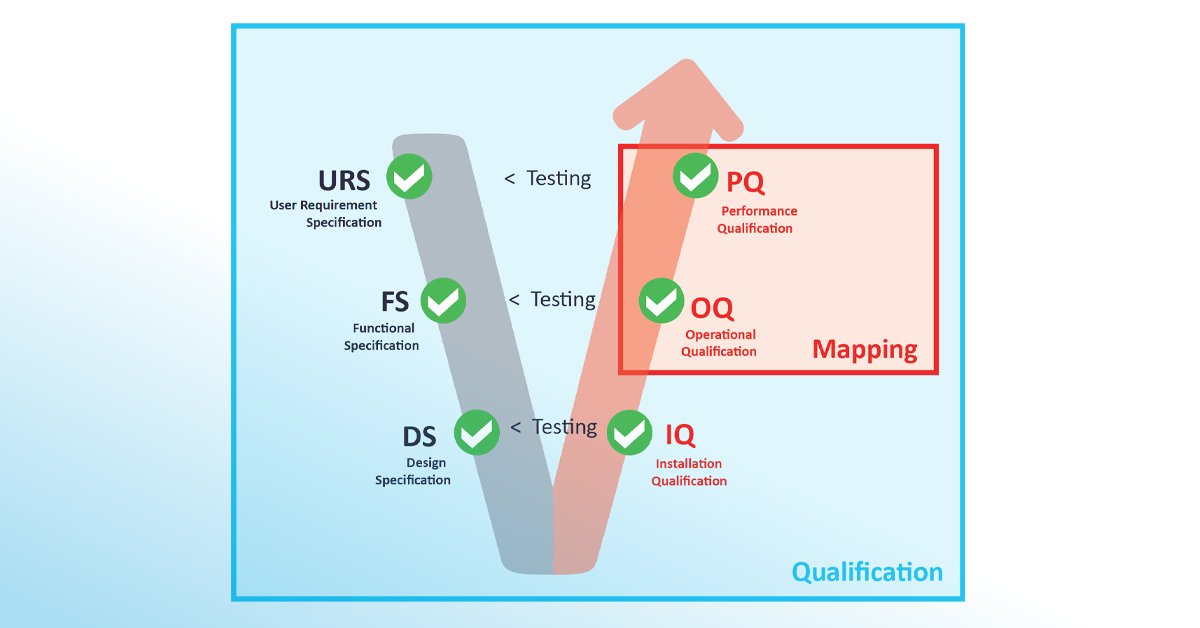
GAMP®5 (Good Automated Manufacturing Practice) is a guidance document that provides a framework for risk-based computer system validation. Under the GAMP® model, a computer system is evaluated and classified depending on its intended use and complexity. The latest GAMP® approach uses a V-model diagram to illustrate the consecutive steps in system validation and contains the specifications established for a particular computer system and tests that constitute the verification process.
Key Elements of GAMP®5
Design Qualification (DQ) – Checks that cleanroom design, systems and equipment align with regulatory requirements. It's important to consider space capacity, layout efficiency, contamination prevention measures and the placement of HEPA filters to control airborne particulates.
Installation Qualification (IQ) – Verifies that installation adheres to design specifications. Comparing installation records with standard procedures ensures readiness for operational testing. Equipment like particle counters and photometers can validate proper installation.
Operational Qualification (OQ) – Evaluates system performance under worst-case scenarios. Tests may include recovery tests to measure how quickly the cleanroom returns to compliant particle concentration levels after simulated contamination, as well as airflow pattern testing to ensure consistent clean air delivery.
Performance Qualification (PQ) – Assesses system performance under normal operating conditions. Simulations test load capacities, contamination control and workflow efficiency. Microbial and particulate monitoring is essential to maintain compliance.
Centralized Monitoring System Validation
Contamination in any cleanroom can introduce discrepancies in product quality, eventually affecting process outcomes. Through environmental monitoring, you can sample process areas to confirm they are operating within the defined parameters.
Autonomous monitoring systems are replacing low-cost manual sensors. With a centralized system, you can integrate all your sensors into one central dashboard, thereby bringing all your data under one roof. This centralization helps eliminate the manual tasks of sensor activation, resetting, and data collection. Additionally, you will enjoy the benefits of automated and seamless data acquisition, distribution, and analysis.
What is Included in a monitoring system?
A monitoring system is a crucial tool in cleanroom requirements and maintaining compliance within a sterile facility. It provides a way to log prevailing ambient conditions that prove compliance to regulatory standards. Additionally, the monitoring system can log deviations from the expected conditions and generate alarms to trigger remedial procedures. Through environmental monitoring, you can avoid product loss and improve process efficiency and product quality.
The system hardware is any programmable device applicable in a quality-related process. A computerized system validation must also include software validation, which provides documented evidence that the software performs according to the design and user requirements. Identifying and eliminating software bugs is part of software validation under the 21 CFR Part 11. The GAMP® requires that every monitoring system maintains information confidentiality, integrity, and availability.
Need a monitoring system for your cleanroom?
ELPRO offers wired and wireless systems.
Learn More